
Low Bias Class AEd Grochowski Written 11-27-2026IntroductionI recently investigated an uncommon type of audio power amplifier that uses the bipolar transistor's exponential relationship between current and voltage to create a hyperbolic sine function. This technique was first described by Peter Blomley in 1971 [1] and later commercialized by several manufacturers [2] [3]. Hyperbolic amplifiers have been the subject of a fascinating discussion on DIYAudio [4]. This type of amplifier may be categorized as Low Bias Class A because all conduction angles are 360 degrees, and the quiescent current is lower than Ipeak/2. To evaluate the hyperbolic technique, I designed two state-of-the-art amplifiers that differ in their output stages. Both amplifiers have total harmonic distortion of a few parts per million - far below what can be detected by human hearing. I named the amplifiers the Hypertron and Symmetron. Like the two monsters in the movies, they were set for an epic battle. THD WarsI evaluated both amplifiers using the Spice circuit simulator. Their specifications are listed below. All values are per-channel.
THD was measured under conditions that produce the most distortion. All significant harmonics were counted. The result was that the Hypertron won with a remarkable 2.6 PPM THD. The Symmetron's 6.2 PPM THD was among the lowest available in audio power amplifiers. The two amplifiers produced very different distortion spectra. Distortion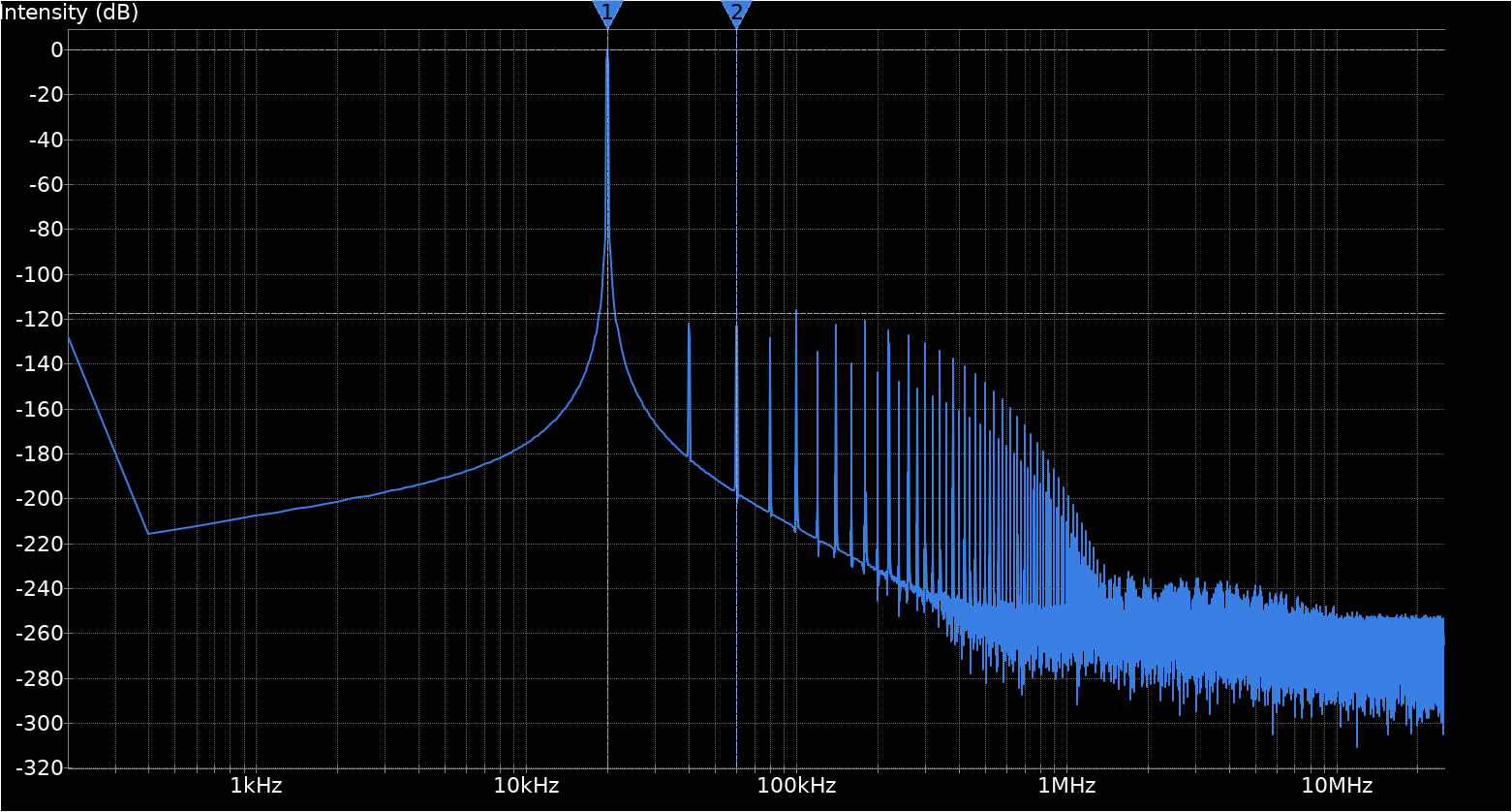
Hypertron Distortion
The Hypertron's distortion is dominated by the third and fifth harmonics. The remaining harmonics fall off rapidly with frequency. This is due to the smooth transfer function of the low bias class A amplifier. 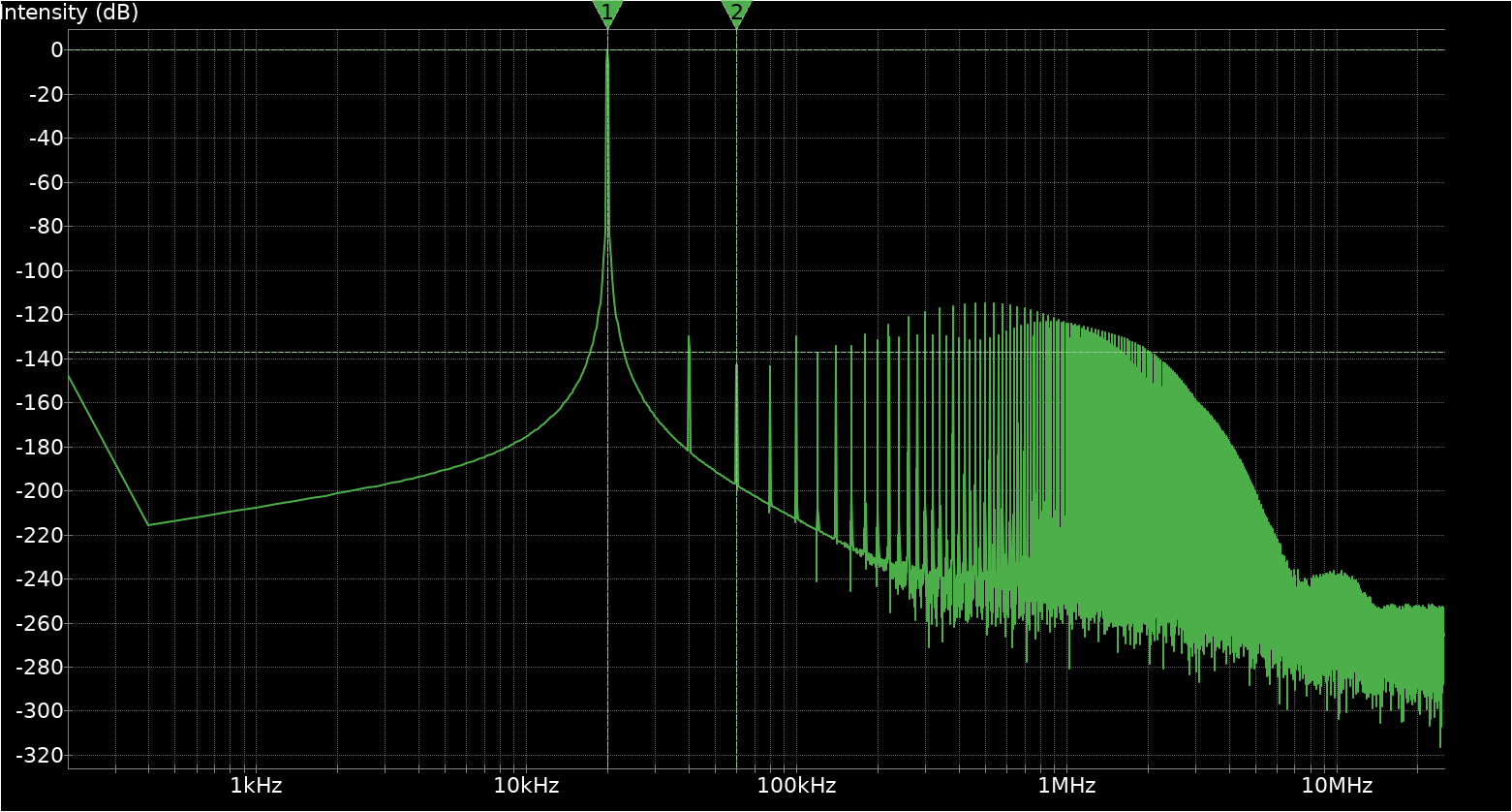
Symmetron Distortion
The Symmetron produces extremely small harmonics below 200kHz due to the use of Transitional Miller Compensation. Above 200kHz, negative feedback becomes ineffective in suppressing the high harmonics generated by class AB crossover distortion. ConclusionThe main conclusion is that it is better not to generate harmonics above 200kHz than to try to suppress them with negative feedback. Amplifiers simply do not have enough loop gain at ultrasonic frequencies. Another conclusion is that the common practice of computing THD by summing first ten harmonics may fail to capture most of the distortion. This is especially true for amplifiers that use large amounts of negative feedback to correct a bumpy transfer function. Finally, while the hyperbolic amplifier succeeds in combining the distortion characteristics of class A with the efficiency of class AB, its commercial success has been limited most likely due to higher power consumption at idle and both amplifiers' distortion being inaudible. While the amplifier designs were evaluated by using a simulator, the Hypertron is sufficiently unlike my previous amplifiers that building it may prove interesting. References[1] Peter Blomley, New Approach to Class B Amplifier Design. Wireless World, February 1971. [2] Yamaha MX-10000. [3] Linear Technology LT1166. [4] Ian Hegglun, Towards a wideband non switching Auto Bias power amp. | ||||||||||||||||||||||||||||||||||||||